
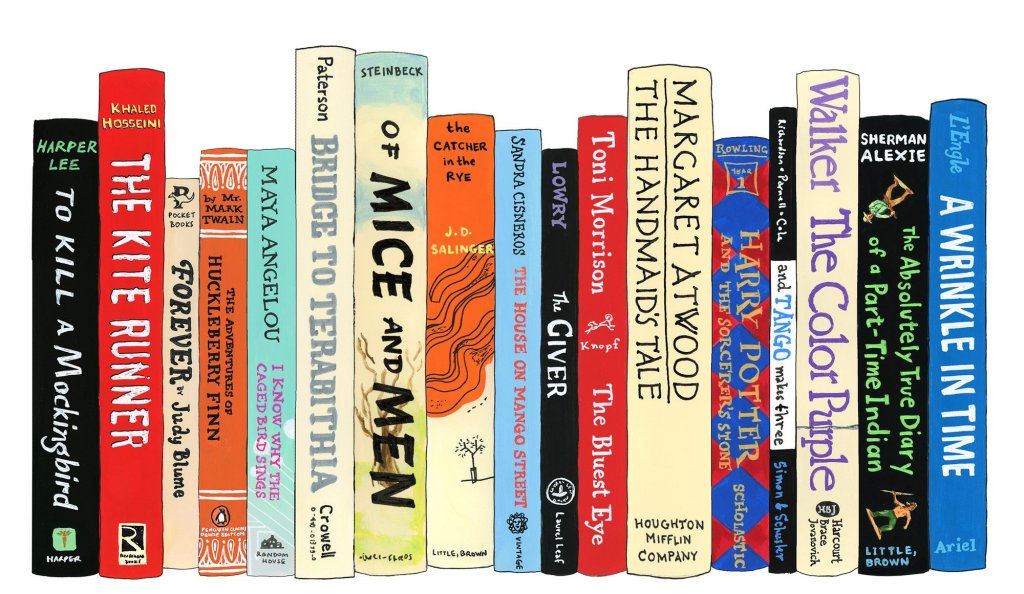
Not too long ago, I googled the most banned books in the American high schools and was semi-surprised to see the list. I remember having done the same for most banned books in the world a couple of years ago, and I was shocked at how different the two lists looked.
Among the top banned books in the world – by governments, I should add – were 1984 and Animal Farm by George Orwell, The Bible, The Communist Manifesto, Brave New World, etc. Among the most banned books were The Absolutely True Diary of a Part-time Indian, And Tango Makes Three, The Catcher in the Rye, Twilight, etc.
Now banning Twilight I understand, but The Catcher in the Rye? And Tango Makes Three? And the reasons given for banning these books were even odder. According to the American Library Association, The Absolutely True Diary of a Part-time Indian was banned because of its sexual references, violence, bullying, profanity, and slurs. And Tango Makes Three was banned because of two gay penguins. The Catcher in the Rye was banned because of its offensive language, sexual explicitness, and unsuitableness for certain age groups. You get the point.
![giphy[1].gif](https://emmakexinwang.com/wp-content/uploads/2019/04/giphy1.gif?w=480&h=226)
Banning Catcher in the Rye because the language of a seventeen-year-old boy is too foul for other seventeen-year-old boys to read is absolutely ridiculous. Society – more specifically, parents and teachers – have blindfolded themselves and stuck a finger in their ears to the fact that children are much more mature than they imagine them to be. You will never meet anyone as foul-mouthed as an eighth-grade boy. The notion that parents have to shield their children from things such as bad language and sex is out-dated and even laughable when compared with the texts society praises. Yes, Shakespeare is full of sexual innuendos.
There are, of course, many other more complex and nuanced reasons for banning books in schools. For example, Thirteen Reasons Why – the book that had been adapted to widely watched series – is banned in certain schools for the romanticization of teen suicide. The eerie cassette tapes and the sort of “adventure” Clay takes on to find out the reason why Hannah killed herself could be easily interpreted as such. Now, of course, there comes the counterargument that the author didn’t intend to have his book interpreted as such, that his intentions were to raise awareness for teen suicide in the hopes of prevention. With this, another series of questions arise: Does it matter that the author didn’t intend something negative even if it has a negative effect? And if it does matter, are the readers to blame for reading the book the “wrong” way? Therefore, if a girl who has contemplated suicide reads Thirteen Reasons Why and decides to kill herself, is that her fault or the authors? Should we ban these books after all?
I am hesitant to give any definite answers to these questions because in typing these out, I have already made myself uncomfortable in my own beliefs. And since the intention of writing my blogs is to make my readers think, here are some more fundamental questions to consider: What are the boundaries of freedom of speech and freedom of expression? What are the criteria we should and should not consider when taking into account? And even when we have defined these criteria, who’s to judge what books should be banned?
![giphy[2].gif](https://emmakexinwang.com/wp-content/uploads/2019/04/giphy2.gif?w=480&h=268)

 Emma Kexin Wang
Leave a comment